


A crossflow cooling tower is a device that can cool water. The water flow falls vertically from the upper part of the tower, the air flows horizontally through the water spray packing, and the air flow is orthogonal to the cooling tower of the water flow.
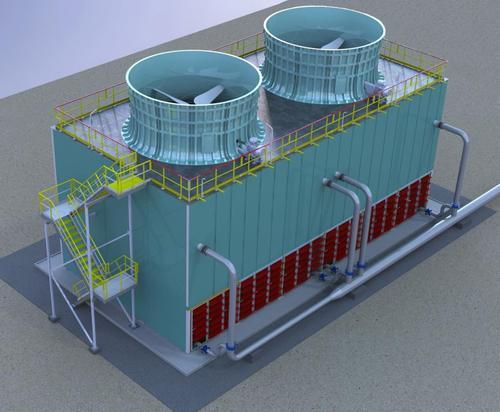
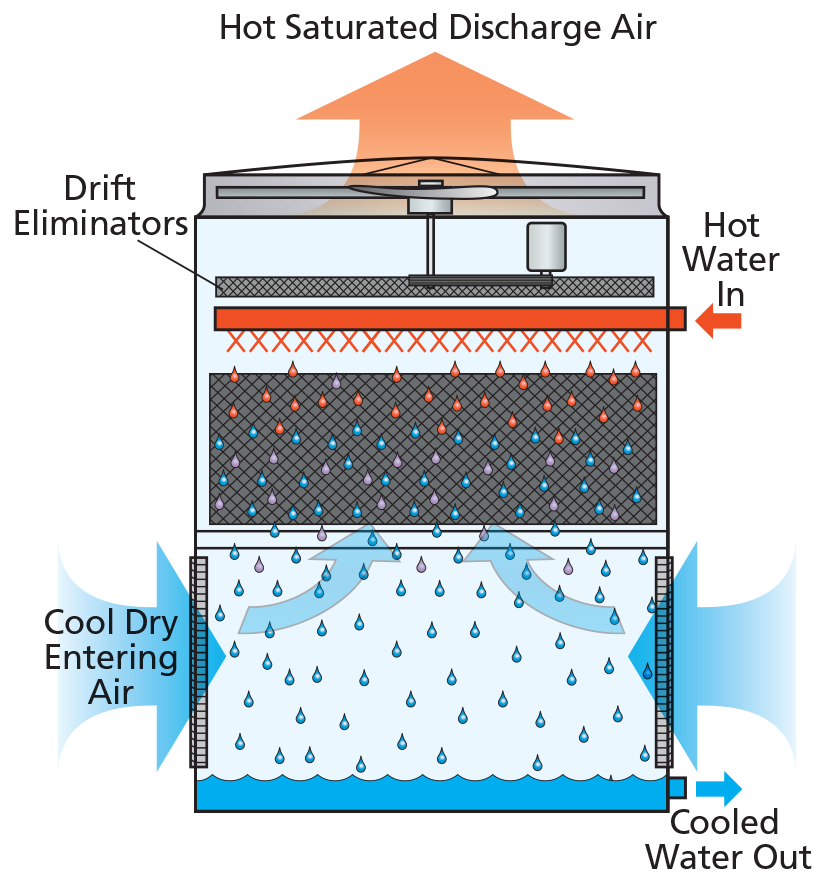
A counter flow cooling tower (counter flow cooling tower) is a device in which the water flow falls vertically in the tower, and the airflow direction is opposite to the water flow direction.
The comparison between a crossflow cooling tower and a counter flow cooling tower is as below:
| Item | Counter flow cooling tower | Cross flow cooling tower |
| Tower height | Due to factors such as the height of the air inlet and the horizontal arrangement of the water collector, the total height of the counter flow tower is relatively high and the volume is relatively large. | Because the height of the fill is close to the height of the tower, the water collector does not occupy the height, so the total height of the cross flow tower is low and the volume is small. |
| Water distribution system | The counter-flow tower uses nozzles to distribute water, which has high pressure requirement, and the nozzles are easy to be blocked. | The cross-flow tower adopts a water distribution system that naturally falls by gravity, the water dispersing holes are not easy to be blocked, and the water distribution is uniform, which maximizes the filling performance. |
| Overhaul | The entire tower body of the counter flow tower is a closed structure, and it must be shut down during equipment maintenance or routine maintenance. | The cross-flow tower body is equipped with an overhaul door, and there is an overhaul space inside the tower, so that the equipment can be overhauled and routinely maintained without stopping the machine. |
| Wind resistance | In the counter flow tower, the water vapor flows in the reverse direction, and the water distribution blocks the airflow, so the wind resistance is higher and the motor consumes more power. | The cross-flow tower is lower than the counter-flow tower, and the higher the air inlet is the higher the packing, so the inlet wind speed is low and the motor consumes less power. |
| Noise | There is a large distance between the fill and the lower water tank in the tower. After the water falls from the filling, the sound of water splashing and falling will be generated and the noise is loud. | The lower part of the fill of the cross flow tower is submerged in the water, so that after the water flows through the surface of the fill, it directly falls into the lower tank with very low noise. |
| Water loss | Since the fan of the counter flow tower is located directly above relatively close to the fill, the amount of water loss is relatively large. In addition, the splash loss of the water in the lower tank is very large, and it is easy to form water mist around the cooling tower, which is easy to cause the reproduction of the legionnaire flora. | The cross-flow tower fan is located in the center of the cooling tower, and the filler is located on both sides, so the amount of water loss is very small, which is an environmentally friendly product. |
| Modularization | The air enters counter flow tower from all sides. The rear of the module group affects the air intake. In order to meet the air volume requirements, the power consumption of the motor must be increased. | The cross-flow tower is specially designed for modularization, with a single unit with air intake on both sides, and the air intake surface will not change after the module is combined, and the power consumption of the motor will remain unchanged. |

Contact:
Charles Soon
Mob/Wechat/whatsapp: 0086 18633315286
Email: sales05@frpexpert.com